tarun verma
about
now readingOrbitalSamantha Harvey
now readingOrbitalSamantha Harveyopen ↗
now listeningGemini RightsSteve Lacy
now listeningGemini RightsSteve Lacyopen ↗

cartoons by kit schluter - review
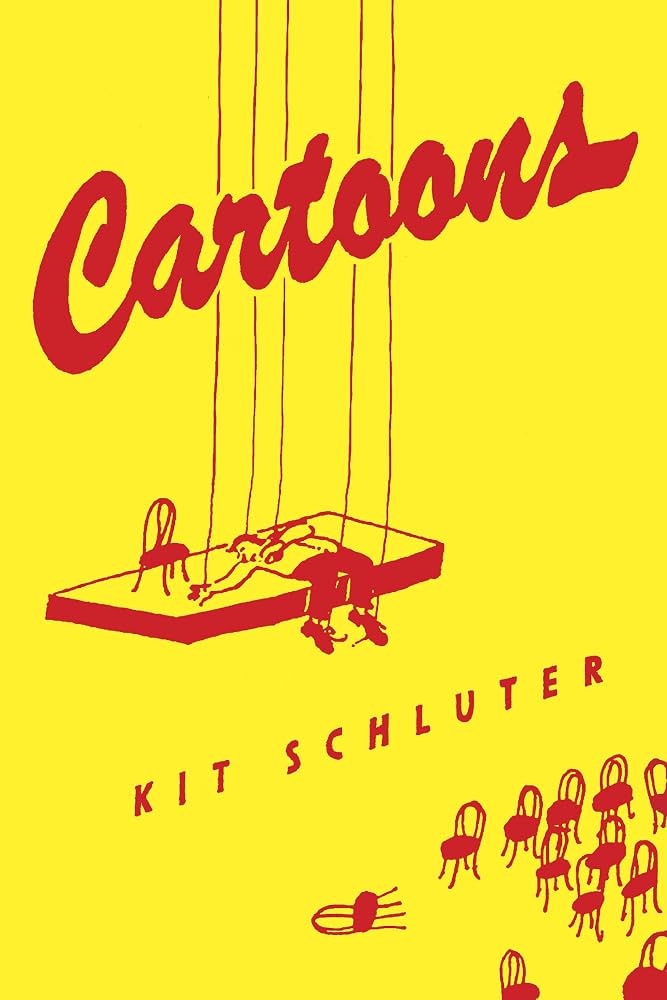
book cover

as the 135 to old street snakes through the little alleyways around westferry DLR and merges onto commercial road, i find myself trying to figure out where i was this past weekend and what i had been up to. the brainfog is intense. it’s another week of withdrawals, and i’m more lost than usual. the upper deck of the bus, relatively empty, shakes and vibrates with some intensity as the bus driver manoeuvres his way through erratic east london traffic. i think about what i’ll get for lunch once i’m in office. i wonder if falafel is good for my gut. i picture the woman i had seen this past weekend, but struggle to place a name to her face. among other things, i speculate if things will be alright.

suddenly, a rat emerges from the row adjacent to mine. it stares at me intensely for a minute and i think to myself, please, i don’t have time for this. it morphs into a humanoid, like that character from harry potter, cracks its spine and then knuckles, and takes the seat across the aisle. through its eyes that are a deep endless black with no pupils whatsoever it stares at me intensely and i look away, pretending to ignore it.

squeak squeak squeak, when will you get to it, tarun?” it asks.

“back to your gutter, will you please,” i respond.

“when?”

i survey the upper deck. there’s just one more passenger who’s busy vaping in the front, completely oblivious to what’s going on. there are about 6 more stops to duke’s place, where i’m supposed to get off. i sigh and turn to the ratperson.

“can you leave me alone, please. look at that kid in the front, look. he’s vaping. it’s probably not allowed on the bus. can you please bother him?”

“when will you get to it, tarun?”

“get to WHAT, you squeaky piece of shit?!”

“all that demands your attention.” it starts to whisk. “what’s inside your heart.”

“what would a ratperson know about it?”

“the ratpeople know. you never come down, it’s always us who have to come up. we know.”

“whatever,” i sigh and look away.

“when will you get to it?”

its voice is grave and sincere but i pay no attention to it. about 3 more stops. there’s another person who’s coming up the stairs. the ratperson notices and begins morphing back into a rat again.

“just remember: there’s no middle path, tarun!” it squeaks as it continues to shrink down.

i pick it up before it can run off and throw it outside of the bus.

someday, people in this city would be grateful for my actions. a statue might also be erected in my honor once london’s finally done with the roadworks.


cartoons by kit schluter is interesting and borderline insane. i felt humbled after reading this book. not humbled in a way you would after attempting something monumental, of great literary significance1 and realising you’ve overestimated your prowess, but, well… i can’t articulate what it is properly, but i thought i knew enough about fiction, that nothing could really surprise me. that no matter how strange and eccentric things got in a book, with some amount of effort i’d be able to see the point, figure out the layered metaphors. the meanings underneath the meanings, masks beneath masks. given enough time, i had thought, no allegory was impenetrable. that things always converged to a point because there always has to be a point.

cartoons changed that. but before i get into why, what it is, briefly: it’s a collection of short stories, the writer’s “cartoons” as he describes them in the preface:

I found I could disarm a feeling if I only picked its dynamics apart into characters and let them, as they say, have at it amongst themselves. What resulted were playful scenes which staged my own questions at a remove, allowing me - now us - to watch them as a spectator. I’ve taken a liking to calling them my little ‘cartoons’.

stories vary in length: some are as short as a single paragraph, some others a few pages2. very approachable insofar as length is concerned. it’s also well written: no unnecessary flourishes commonplace in a lot of weird lit.

on to the subject matter, then. throughout my time reading this, which was during my already dreadful commute to/from work, i felt a range of emotions: wonder, disgust, awe, amusement, dread, boredom. i was even vexed at certain fairly short pieces which were neither poetry nor prose and in their (intentional) attempt to be neither just read like jumbled sentences, often full of schizoid characters dropping nonsequiturs. objects and animals and humans morph and shrink and grow and die and reborn and die again and talk about all that is important and not in a tone that’s often perplexing but always hilarious. it’s not immersive, per se, but it’s definitely intriguing. you kinda want to know what these characters are up to, where their intentions lie, why they behave in their extremely strange ways. i thought about these cartoons for a while. in fact, for a book that’s fairly short (~130 pages), it took me longer to finish this than wise blood, which is almost double in length.

i tried to understand where kit’s mind was when he was writing it all. and sometimes i did, and when i did, i felt seen. take this one, for example, titled: “I AM NOT A HAPPY PERSON AND I DON’T LIKE MY FRIENDS (subtext: A CARICATURAL ESSAY ON 120 DAYS OF SODOM)”. it’s a little autofiction piece which involves:

  • kit who is not a happy person and hates his friends and visits the same café everyday,
  • a shoeshiner who frequents the same café, is always annoyed at the kit’s dirty shoes and hatches a plot to forcefully clean them by conspiring with the waitstaff.
    • and later reveals that he just wanted to be bathed in kit’s piss.
  • a waiter who has orchestrated this entire ordeal to just talk to kit about commitment issues.

all this and more takes over just a few pages. this short opened with a direct quote by sade, so i was sort of expecting the weird sexual shit. what left a deeper impression on me however was how kit was able to ground this extremely outlandish and absurd situation into something sincere. personal struggles that i found deeply relatable were captured in a manner that goes beyond the pop-psych vocabulary and understanding of commitment, attachment, and relational troubles. because a lot of this stuff is incredibly personal and cannot be understood through the lens of the lowest common denominator, expressing it all instead through the absurd felt fresh in a way a lot of literary fiction hasn’t for me so far. i mean, there are probably some books i’m unable to remember at the time of writing this that probably got close, but cartoons read like something genuinely novel.

a huge challenge in writing (particularly in literary fiction) is articulating inner states while not getting too lost in the sauce. at the same time, you want your writing to be personal enough so that it isn’t reduced to just another mainstream airport paperback. in the preface to this book, kit mentioned that a lot of this is a “personal psychological experiment”, which rings true in my reading of it. the strength of this book to me lies therefore in how deeply individual, well expressed, and entertaining it is. don’t get me wrong, i still don’t get most of it. that’s to do with the humbling part i mentioned in the beginning. but beyond all that, this book made me realise that there’s a ton i don’t know about the craft of fiction. it served as a reminder that i need to get out of my comfort zone and maybe experiment more. inspiration favours the bold.

do NOT give this book a try if you don’t have an active imagination and/or don’t fuck with surrealist black humour.

footnotes

  1. which is not to say this book can’t be one day

  2. i read this on a pocket reader, so page size/length wouldn’t translate 1:1 with a paperback

a very indian failure

one of the more important books i’ve read in the past couple of months is julian baggini’s “how the world thinks” 1. i had picked up this book way back in 2022, on what was (i think) my fist visit to the foyle’s at charing cross road. i don’t read a lot of nonfiction, but i do harbour a soft spot for philosophy/ethics/critical analysis, and the book’s tagline (“a global history of philosophy”) had tempted the eyes of yours truly: a curious and somewhat depressed recent immigrant. as one does, i promptly forgot about this book afterwards, and only came across it recently while cleaning my bookshelf. 9

“ah, well. fuck it. might as well,” i thought.

i have finished this book now. it’s very readable - more at the existentialist café than the burnout society, although that’s to be expected with survey books2. it presents during the first few pages an obvious-in-retrospect idea that the philosophy of a culture is the underlying “software”3 that can help understand how that culture has evolved to be where it is in the present moment. it goes over the following extremely broad “quarters” of global philosophy:

  1. east asian philosophy (china/japan etc.): ideas about harmony, virtue, being one w/ nature, aesthetics, etc.
  2. indian philosophy: vedanta/charvaka, death/rebirth, karmic cycle, nirvana etc.
  3. muslim philosphy: falsafa vs qalam, the dominance of theology and quran, etc.
  4. western philosophy: rationality, utilitarianism, individualism, etc.

i grew up under the influence of (2)4, which i believe makes me an authority figure in this area. i have things to say and vitriol to spread.

i think the author of the book was very fair to all of the schools, and i do appreciate a lot of very positive takes on charvakan thought, which imo is extremely underrated. go read about them! but i’m only positive on sundays, and it’s a wednesday at the time of my writing this. i love that the author spent time throughout the book indirectly implying how india’s dominant philosophical doctrine has failed its people, dropping bangers such as:

there are certainly more godforsaken places, but has anywhere been so forsaken by so many gods?

and it kinda makes sense, doesn’t it? if you’re an indian reading this, haven’t you had some version of this exact thought while driving past mounds of garbage littered on national highways? while trying to simply breathe in the country’s capital? or while trying to follow basic traffic rules, and being told that that’s “not the way”? the author himself notes while traveling across bodh gaya in bihar that:

i’ve been to places at least as poor in east africa, but none were as dirty.

which took me back to when i was 19, maybe 20, to this little trip to haridwar i was on with my family at the time. i’d always had issues with this place: while i appreciated the scenic beauty of some of the sites around, i could never bring myself to walk through the absolute dirt and grime littered on the streets around har ki pauri, which one often had to navigate bare-footed. i used to complain to my parents about this: “why is everything so dirty? can we go to a gurudwara instead?” barely ever was i given a satisfactory reply. what made me angrier was that this was not only accepted, but celebrated. often i was told that this is close to the hermetic/sadhu life, that dirt and grime humbles you. chanting the name of some god i no longer remember, i was in the middle of taking dips in the holy river when i saw an actual piece of shit float past me. humbled, i came out, rubbed myself dry, and swore to my parents that i’m never coming back to haridwar again. i’ve kept my word on that since.

i was extremely religious as a kid5, but experiences like the one above had slowly gnawed at my psyche. as an adult now, especially as an adult who’s moved around a bit and travels often b/w london (where i work) and delhi, it’s difficult to not pay attention and draw comparisons.

i’ve been thinking about this obsession most of us (indians) have with the karmic cycle, particularly with rebirth/reincarnation (or a complete exit). i mean, i understand that most organised religion is prescriptive6; the particular prescription i’m somewhat mad about is using your current life as a means to an end: to make the next life “better”, whatever that even means. i mean, there might exist some instruction in some footnote of a veda around trying to be a decent human being in the present: being helpful not because it will guarantee you a better next life/ticket to heaven, but because it’s the right thing to do. from what i have seen though, such instructions are pretty much nonexistent in practice. when i look back and ponder about the actions and intentions of my elders, whom i was taught to adulate and never question, i notice nothing but the same self centred doctrine at play. just fulfil your duties: pray to some of the million and a half gods, bring money and offerings to the same institutions that have upheld casteism and other social evils for centuries, get your kids married in time7, make sure they have grandkids in time. never ask if they want any of these things: be a man of dharma. there’s a laundry list of such action items, and best believe very few of them have to do with becoming an actually considerate and attentive human being… attentive to the wishes of your kin, to your community; attentive towards the environment, towards the future generations.

another thing that pisses me off is the lack of accountability. oh, did something not work out? did you fail in some personal aspect of your life that was very fixable if you had owned it up and tried to correct your actions? you know, learn from your mistakes? no. let’s never do that. mistake? what mistake? let’s discuss rahu-ketu instead. actually, no. let’s go to this jyotish right around the corner. he has the answers. he knows why you haven’t been able to get a job, or why you aren’t getting married. even if your life is miserable, and you’re making it miserable for everyone around you, please never stop and reflect on the idea that maybe this way of life isn’t for me. instead, go ahead and force it on everyone, ad infinitum. once the masses concede, they’ll see the point.

unfortunately, ceding their own individual thought and aspirations to serve theological doctrines will have your masses live in constant pain, frustration, and anger… anger that they will take out on their spouses and siblings and their rivers and their land. and you will walk around and see mounds of garbage and misery in plain sight signalling to you an absolute systemic failure, and all you’ll still worry about is the evening prayer.

and then you die and maybe you do go to heaven, but was it worth it, rakesh?

footnotes

  1. i recommend it if you’re interested in an introductory text!

  2. i don’t know if that’s what these type of books are actually called, don’t shout at me

  3. please understand: i liked this analogy NOT because i work with software systems, i just found it neat, okay?

  4. additionally, i live under (4), and obsess about (1)

  5. i was once reprimanded by my science teacher for using all of my free time cramming aartis instead of studying for unit tests

  6. which is why i’m agnostic/spiritual at best; i don’t like associating with atheists either, not a very likeable bunch imo

  7. or else face communal backlash and/or neurosis

spaces

my mother told me some time back that my great grandfather fought
for the empire back in world war 2
disposable (like most soldiers from the colonies)
he was presumed dead for about 8 years, k-i-a
but then one day he came back, scrawny and scraggly
and my mother who must be very young back then thought that he wanted a coin or two
and turned him away


but he persisted and then my mother’s father showed up and it was a tearful reunion
and my mother didn’t recall much but did say that he camped with enemy soldiers
equally abandoned, stripped away. no one was coming for them back then, this
they had known even when they were drafted.
but they were all desperate and more than vulnerable,
and confessed that they needed each other,
and that’s how my great grandfather had survived.


a lot has gone wrong since. modern weapons: controlled pigeons
sent from elsewhere
messengers of death
creating ever more spaces
between us